


Transforming Our Sector
The building and construction industry is the world’s largest consumer of raw virgin materials while also being the largest producer of solid waste. Little thought is given to how building materials might be efficiently recovered and reused. Economic pressures mean that low quality and chemically modified composite materials dominate modern construction methods. Urgent change is needed to reduce the impact of construction on the environment and ensure our buildings are designed for the future.
The Circular Economy (circularity) is a collection of design and specification criteria that aim to improve the ability of a product’s (or building’s) constituent parts to be recovered and reused. The ultimate ambition of circularity is to eliminate waste by creating an economy that is ‘circular’. In this economy, products (such as buildings) must be designed to allow components to be recovered and reused without creating damaged, contaminated or waste materials.
Applying the circular economy to buildings is a crucial step in reducing waste and lessoning the negative impact of modern society on our planet. Buildings are the largest consumer of new raw materials, and are responsible for more than 30% of the world’s waste. In nations with a younger building stock and less sophisticated material recycling methods (such as New Zealand, Australia and the United States), construction waste can represent up to 50% of total annual waste volumes.
Circularity in buildings is best achieved through design and specification. The type of spaces created, the shape of those spaces, the materials selected and the type of structural and fixings systems adopted all significantly influence end-of-life deconstruction and reuse performance. Adherence to the guidance in this document will ensure spaces are designed in alignment with the aims of the Circular Economy.
Material selection dictates how different building layers can be connected to one another and the type of material recovery possible at end-of-life. Using high quality non-composite materials means that reuse is more likely (as the material has more inherent value). Non-composite materials also have the benefit of being able to be recycled within clean high-value recovery schemes.

Efforts to adopt standardised and interchangeable components on a large scale increases the likelihood of component reuse. The more similar components deployed, the higher the recovery value of those components. Rationalising wall lengths to industry standard sizes and separating bespoke architectural elements ensures that reuse is the most attractive end-of-life option.
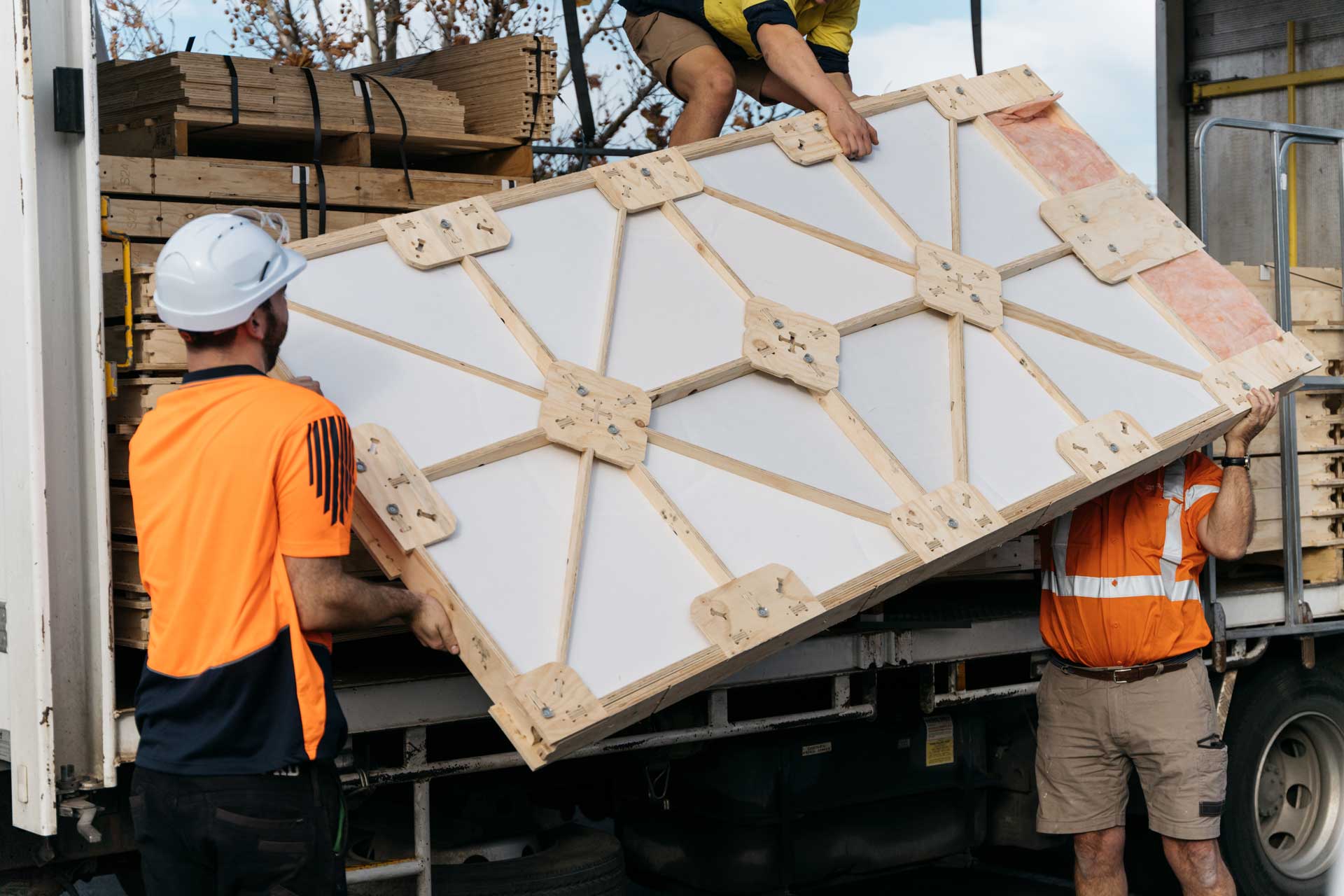
Every building component should be designed as a series of independent, interchangeable layers. These layers should never damage or compromise adjacent layers. Those most frequently modified should be easily removable in a damage-free manner. Any potential tertiary finishes or components that may limit the modification of these layers should be minimised.

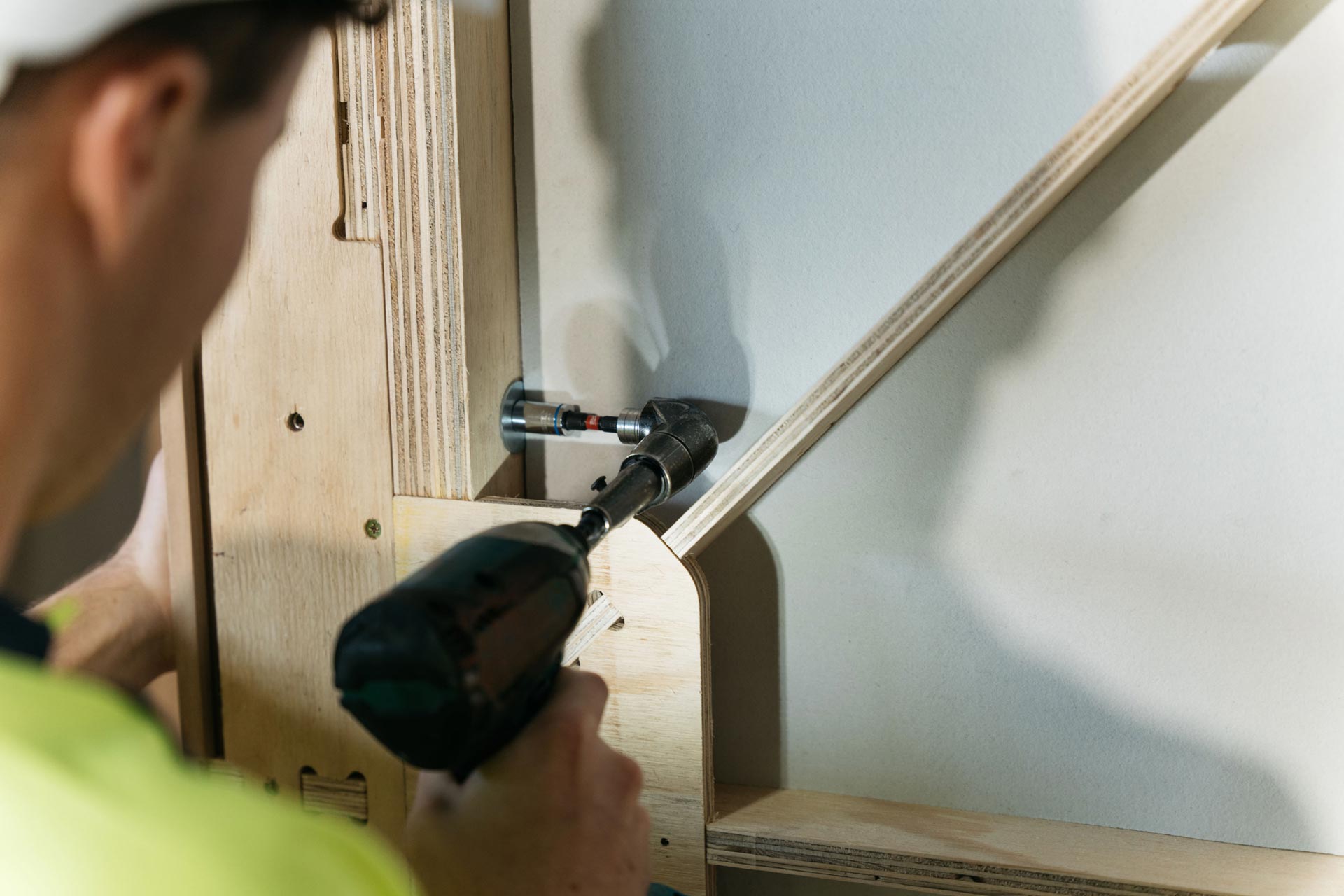
The methods used to connect secondary building elements to structural members must be easily reversible. These fixings also need to avoid damaging themselves, the elements they support and the members they fasten into. All adopted fixing systems need to be reversible by unskilled end-users and not impact the structural resilience of primary elements.
Consider a building as a series of independent layers with different life-spans, helps with the practical implementation of circular design.
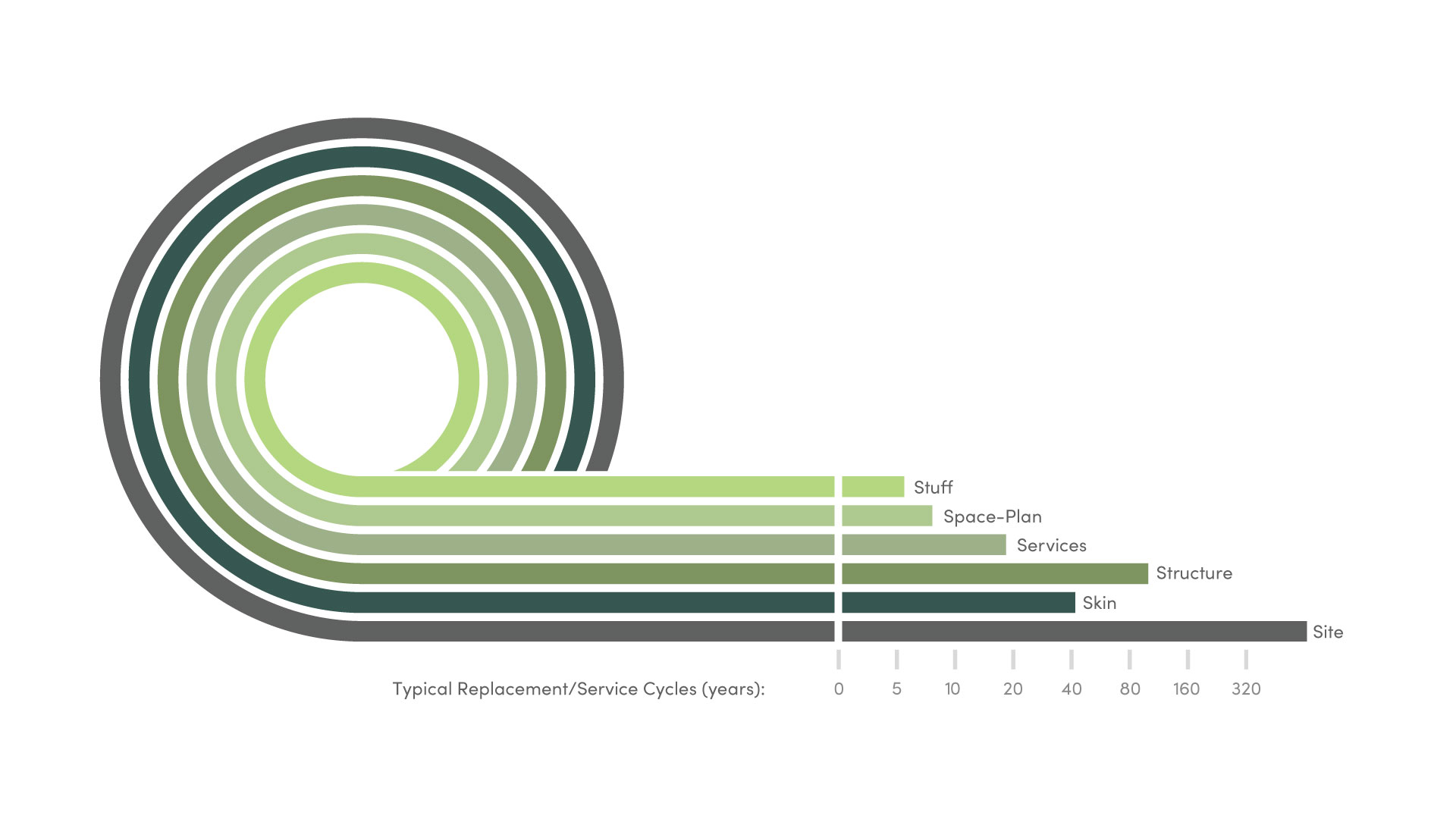
The site in which the building is located. The building’s connection with the land, water and other built environment elements such as roading and public transport.
Typically outside the scope of interior works. Building envelope layers including cladding (exterior visual elements) and secondary weathering layers (building wraps, cavity systems, external insulation and junction elements).
Primary structural systems of buildings (including structural walls, structural columns, beams, structural flooring systems, lateral bracing elements and foundation systems).
Various systems in the buildings, including mechanical, electrical and plumbing systems. The physical relationship of these items with structural and space-plan layers must be considered to achieve end-of-life recovery.
Interior space elements that are fixed to the superstructure (wall finishes, ceiling finishes, floor finishes, internal non-load-bearing walls, suspended ceiling systems, raised floor systems, doorways, hallways, service walls).
Objects in spaces that are either not fixed to the Space-Plan, or those that are fixed but easily removable. This may include furniture, storage items, supplies, vehicles and electronics.
Getting started with
XFrame is simple.
1. Reach Out
We meet, review your concept, and discuss your requirements further.
2. Quote
We show you what your design looks like in XFrame and put together a proposal with transparent pricing.
3. Deployment
Once your plans specifying XFrame have been finalised and sent to your chosen builder, we get
to work.
